
Organizational Transformation Change Management
Beyond the Methodology
A Philosophy for Sustainable Enterprise Evolution
Let’s Start a ConversationThe Enterprise Challenge
Organizations can achieve local success across strategy, people, processes, governance, technology, and Artificial Intelligence without creating coherence across the enterprise as a whole.
Read MoreA Different Mindset
At Volante Consulting, we view the enterprise through a different mindset; a fundamentally different premise.
Read MoreOrganizational Capability Engineering
We engineer the enduring capability of the enterprise itself so people, leaders, teams, and AI partners can succeed, adapt, innovate, and serve with purpose.
Read More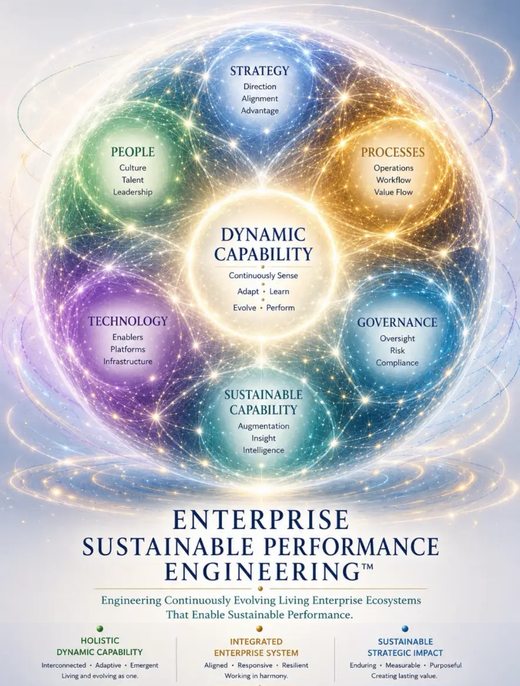
Professional Experience
Over more than two decades, our professional experience has included strategic planning, business intelligence, forecasting and statistical analysis, organizational transformation, enterprise transformation, technology implementations, supply chain and logistics, program oversight, strategy execution, business transformation, and leadership initiatives across organizations including:










Across industries, countries, and cultures, our approach has helped organizations realign strategy and operations, strengthen program delivery, optimize operational efficiency, and restore complex initiatives to successful execution. The common thread has always been the same: delivering sustainable change by increasing the enterprise’s own capability—creating lasting capacity that continues well beyond our engagement.
Origins
What Our Experience Has Taught Us
Beyond the Methodology did not begin when I became an independent consultant.
Its foundations reach back to the beginning of my career.
I began as a statistician with one of the world’s leading banking consulting organizations. My work taught me to look for patterns rather than isolated events and to use evidence to understand what was actually happening rather than begin with assumptions.
At the same time, I was helping develop some of the earliest Business Intelligence models and was strongly encouraged to move into product ownership.
Yet another pattern was emerging.
I became increasingly recognized for my ability to explain complex mathematical and technological concepts in practical business terms—and to help clients understand their own responsibility for the information, decisions, governance, and operational inputs required for technology to produce the outcomes they expected.
That changed the conversation.
Technology was frequently being blamed for operational challenges.
Yet technology was often doing precisely what it had been designed and instructed to do.
The deeper questions concerned strategy, governance, decision rights, roles, workflows, information, and the consequences of the choices being made throughout the enterprise.
Those conversations increasingly brought operations, technology, senior executives, CEOs, COOs, and boards to the same table.
Leadership had to understand not only what it was asking the organization to accomplish, but the operational consequences and costs of those decisions.
Employees, in turn, needed an enterprise that gave them a fair and realistic opportunity to succeed.
That required strategic alignment first.
Only then could governance, workflows, roles, technology, expectations, and execution be intentionally aligned.
Over time I was repeatedly assigned to difficult engagements—often projects that had stalled, become politically complicated, lost priority, or required renewed client confidence.
Those assignments took me throughout Latin America, Canada, and into increasingly international work.
Sometimes I spoke the local language fluently.
Sometimes I did not.
What I learned was that meaningful communication was not ultimately about vocabulary.
It was about understanding.
I learned how to communicate across cultures, disciplines, organizational levels, technologies, and different systems of thought.
- Leadership spoke strategy.
- Operations spoke execution.
- Technology spoke capability.
- Finance spoke performance.
- Governance spoke accountability.
- Employees spoke lived experience.
“The objective is not to make organizations dependent upon exceptional individuals. It is to intentionally engineer an enterprise that enables people to consistently succeed because the enterprise itself has been designed to support them.”
Each held an important part of the truth.
The challenge was rarely that the knowledge did not exist.
The challenge was that the conversations required to connect that knowledge were not always being intentionally facilitated in a way that could produce constructive resolution.
My role became helping those different languages become one conversation.
I did not arrive knowing the client’s business better than they did.
I did not assume I knew their industry better than they did.
I did not bring one predetermined solution and declare it a best practice.
I learned as I journeyed with them.
I listened.
I asked questions.
I helped different perspectives become visible.
I facilitated alignment.
I helped leadership understand the consequences of enterprise interdependencies rather than expecting the workforce to resolve those interdependencies on its own.
And once alignment had been achieved, I helped organizations operationalize that understanding through governance, workflows, roles, technologies, systems, and operating models capable of sustaining the decisions that had been made.
The objective was not to make the organization dependent upon a consultant.
It was to help build an enterprise increasingly capable of sustaining itself.
A workflow-grounded enterprise.
A role-driven enterprise.
An enterprise in which roles and technology are intentionally designed together because each shapes what is possible for the other.
An enterprise in which success is embedded in the operating model rather than dependent upon extraordinary individuals carrying organizational complexity on their shoulders.
Looking back, I now recognize that I was not simply solving operational problems.
I was helping organizations learn how to intentionally design themselves.
That experience became the foundation of Beyond the Methodology.
“Leadership deserves systems that faithfully execute strategy. People deserve systems that allow them to succeed fairly. Beyond the Methodology intentionally engineers the enterprise that makes both possible.”
What People Experience
Across industries, organizations, cultures, and leadership teams, the experiences are remarkably familiar.
People are working hard.
Leaders are under extraordinary pressure to deliver.
Organizations continue investing in transformation, technology, restructuring, process improvement, and new ways of working.
Yet people throughout the enterprise often experience the consequences of systems that have evolved faster than they have been intentionally designed.
- Continual pressure to deliver more with less
- Competing priorities
- Initiative overload
- Increasing organizational complexity
- Repeatedly solving the same problems
- Knowledge lost between initiatives
- Unclear or conflicting decision rights
- Difficulty sustaining improvements
- Fragmented governance
- Operational noise
- Technology frustration
- Process fatigue
- Limited time for strategic thinking
- Employees compensating for gaps between functions
- Transformation activity without lasting enterprise capability
- Talented people spending increasing energy navigating the enterprise rather than creating value
These experiences are rarely isolated problems.
They are often symptoms of an enterprise whose interconnected operating system has evolved over time without being intentionally engineered as a coherent whole.
A Cry for Help
In our experience, this is often the point at which organizations reach out.
Not because they have avoided investing in change.
Quite the opposite.
Many have already committed significant time, executive attention, financial resources, and organizational energy to transformation.
They have sought outside expertise.
They have engaged respected consulting firms.
They have implemented recognized methodologies.
They have adopted industry best practices.
They have invested in technology.
They have reorganized teams.
They have launched transformation programs.
They have genuinely tried.
Yet sustainable success remains elusive.
And after multiple initiatives, leaders can find themselves with more activity, more frameworks, more recommendations, and still less clarity about how the pieces fit together.
The questions begin to change.
Why does every transformation seem to require us to begin again?
Why are we continuing to solve problems we thought we already solved?
Why is organizational knowledge so difficult to preserve?
Why do improvements struggle to become lasting enterprise capability?
Why are talented people working harder while becoming increasingly frustrated?
Why are our technologies not producing the outcomes we expected?
Why do individual best practices fail to become one coherent way of operating?
The Enterprise Challenge
Enterprise transformations often fragment before they can cohere.
Strategy, people, processes, technology, governance, knowledge, and decisions about Artificial Intelligence are typically planned and managed through separate structures. Each may succeed on its own terms. The enterprise, taken as a whole, does not automatically become coherent.
Local success does not aggregate into enterprise coherence.

Separate planning cycles produce separate answers to the same enterprise questions.
Meaning drifts between functions, systems, and leadership teams.
Governance is assembled after decisions are made, not before.
Artificial Intelligence is bolted onto local tools before the enterprise decides what it should mean.
Improving parts remains valuable but individual optimization does not automatically optimize the whole enterprise, stagnating both enterprise as well as individual advancement.
A Different Mindset
Every generation of leaders inherits new challenges. Most respond by improving existing methods, introducing new methodologies, or adopting external best practices intended to help organizations address the needs they face.
We believe this is no longer enough. More importantly, we believe that, in many cases, it has become part of the problem.
Continually introducing new methodologies, frameworks, technologies, and external best practices into an already fragmented and convoluted enterprise often increases complexity without providing durable, sustainable resolution.
The cost—in time, resources, organizational energy, and human capacity—is one that today’s competitive environment increasingly no longer permits. Rather than accelerating progress, organizations can find themselves caught in continuous cycles of implementation, change, and adaptation without ever resolving the underlying conditions that created the need for change in the first place.
- Organizational stagnation
- Declining morale
- Transformation fatigue
- Diminished confidence
- Fragmented decision-making
- Reduced trust
- Increasing complexity
- Slower execution
- A declining capacity to respond to the next challenge
At Volante Consulting, we view the enterprise through a different mindset; a fundamentally different premise.
Organizations are not collections of independent functions, methodologies, projects, or technologies. They are living enterprise systems whose capacity to survive, perform, pivot, adapt, grow, and evolve is created and sustained through the intentional governance and continual realignment of mission, vision, strategy, people, processes, technology, and the Human–AI Partnership as one coherent, living, and intentionally evolving enterprise system.
Organizational Capability Engineering
Methodologies remain valuable instruments. But no single methodology, project, function, technology, or individual engineers the enduring capability required for an enterprise to govern, perform, adapt, innovate, and continually evolve as one coherent system. Organizational Capability Engineering treats the enterprise’s enduring capability—and the intentional alignment of mission, vision, strategy, people, processes, governance, technology, and the Human–AI Partnership—as the primary object of design.
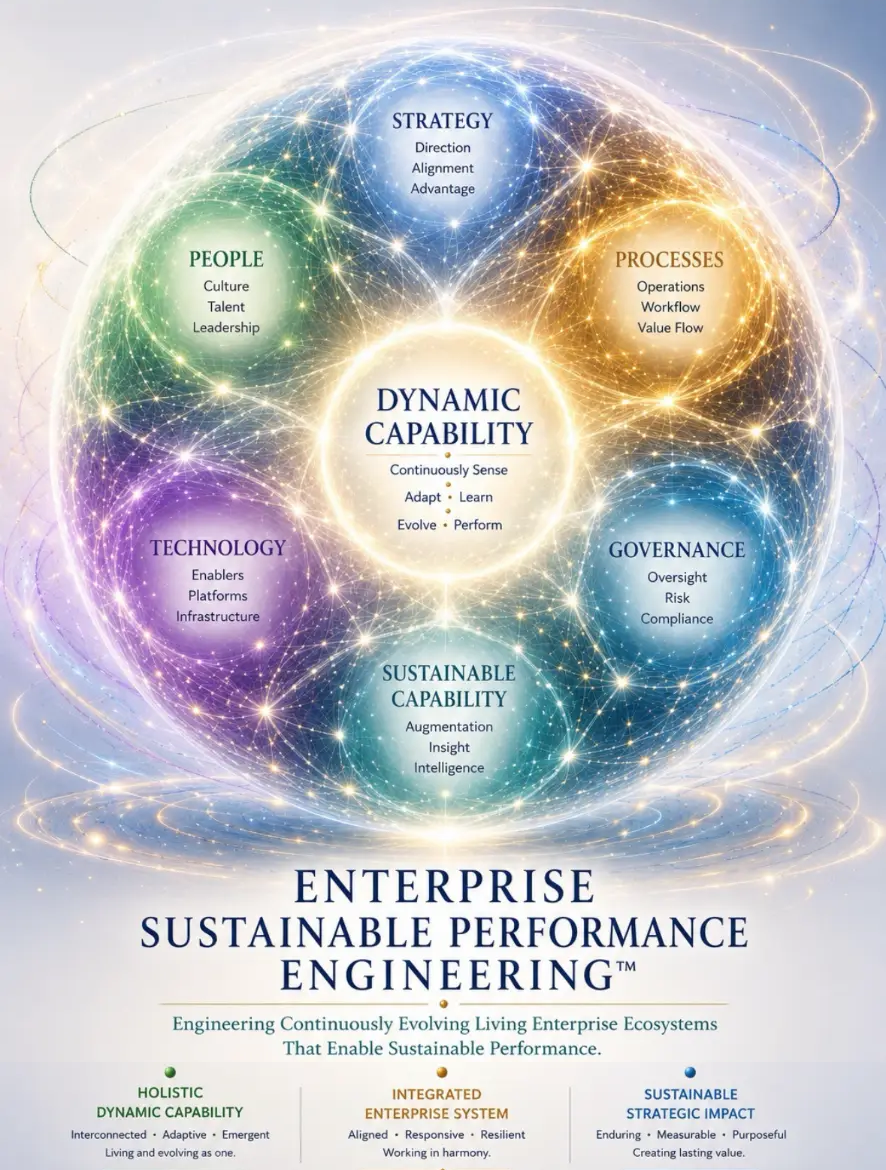
The current Enterprise Sustainable Performance Engineering conceptual model illustrates the integrated, living enterprise capability that Organizational Capability Engineering is designed to create and sustain.
- Strategy
What the enterprise is choosing to become — and choosing not to.
- People
Roles, capabilities, relationships, and lived experience of work.
- Processes
How coordinated work actually happens across boundaries.
- Technology
The systems that carry meaning, decisions, and execution.
- Governance
Who decides what, on what basis, and with what accountability.
- Human–AI Partnership
Artificial Intelligence reasoned about at enterprise scope, as a partner within the system rather than adopted tool by tool.
The enterprise becomes the enduring platform. People, leadership, governance, technology, and Artificial Intelligence all contribute to that platform. The discipline itself is concerned with engineering the enterprise’s enduring capability rather than optimizing any single component in isolation.
Our Philosophy
The objective is not to engineer better people. It is to engineer the conditions in which people, leaders, teams, and Artificial Intelligence partners can contribute their best judgment, creativity, and capability to the enterprise.
The platform exists to let human contribution flourish. When the operating system is sound, the humans inside it can focus on the work that only humans can do.
Respect the Journey
Organizations are defined not only by the destinations they reach, but by what they become along the way.
Protect the Heart
Every enterprise has a heart. It is the human desire to contribute. The operating system exists to protect and enable it.
Trust the Operating System
Confidence is not a feeling. It is an engineered property of the enterprise.
Human–AI Partnership
Artificial Intelligence does not replace human judgment. It expands the breadth of knowledge available to it.
We engineer enterprises that protect the human heart, continually build organizational capability, and confidently pursue the right journey.
Professional Experience Spanning Organizations
Who We Serve
Executives accountable for the enterprise as a whole — not for a single function, programme, or platform.
Over more than two decades, our professional experience has included strategic planning, business intelligence, forecasting and statistical analysis, organizational transformation, enterprise transformation, technology implementations, supply chain and logistics, program oversight, strategy execution, business transformation, and leadership initiatives across industries, countries, and cultures.
Across those environments, our approach has helped organizations realign strategy and operations, strengthen program delivery, optimize operational efficiency, and restore complex initiatives to successful execution. The common thread has always been the same: delivering sustainable change by increasing the enterprise’s own capability—creating lasting capacity that continues well beyond our engagement.
How We Help
Through Organizational Capability Engineering: the deliberate design of the enduring capability an enterprise needs to govern itself as one coherent, adaptive system.
Why Beyond the Methodology
Methodologies improve instruments. Beyond the Methodology governs the whole — through a working theory and an operating model, the Beyond the Methodology Operating System.
Enterprise Systems Theory
A working theory for understanding the enterprise as one system.
At executive fidelity, Enterprise Systems Theory describes the enterprise through five foundational dimensions. It does not claim scientific proof or universal validation. It is a developing theoretical foundation for a new operating model.
Five points — Relationship, State, Time, Constraint, and Purpose — placed evenly around a central circle labelled 'Enterprise as an adaptive system'. Every point is connected to every other point to indicate mutual dependence.
Executive fidelity. Detail and derivation are treated in the Theory section.
- Relationship
How elements of the enterprise stand in relation to one another.
- State
What is presently true of the enterprise and its parts.
- Time
How the enterprise moves — cycles, sequence, and history.
- Constraint
What limits, enables, and shapes what the enterprise can become.
- Purpose
What the enterprise is intending, and for whom.
Beyond the Methodology Operating System
Beyond the Methodology Operating System (BTM-OS) is the operational expression of the theory and the philosophy. It is where meaning becomes coordinated action, connecting ontology, semantic meaning, governed knowledge, governance, decision support, AI enablement, execution, observation, evidence, learning, feedback, and the experiences the enterprise publishes to itself and to others.
Five stacked layers from bottom to top: Ontology and Semantic Foundation, Governed Knowledge, Governance and Decision Support, Execution and Observation, and Published Experiences. A vertical arrow on the left indicates meaning flowing upward and feedback flowing downward.
Meaning is governed before it is represented — in documents, dashboards, websites, AI contexts, and knowledge systems.
The preview describes the conceptual layers of BTM-OS at executive altitude. It deliberately withholds implementation specifics that are not yet inside the approved disclosure envelope. What is public is what can be published as governed meaning today.
- Ontology and semantic meaning as the foundation
- Governed knowledge as the substrate for Artificial Intelligence
- Governance and decision support as one layer
- Execution, observation, evidence, and learning as continuous practice
- Published experiences carrying the same governed meaning everywhere
Our Philosophy
The Four Foundations of Our Philosophy
The credibility of any philosophy rests upon the strength of its foundation. Ours rests on four.
Empirically Derived
Grounded in more than two decades of enterprise experience across industries, countries, cultures, and organizational environments.
Continuously Tested
Strengthened through continual challenge, validation, observation, and iterative refinement.
Intentionally Engineered
Structured into a governed operating model through an intentional Human–AI Partnership.
Continuously Practiced
Applied, refined, and strengthened through real-world enterprise engagements and through continual evolution.
Expressed through
Why · What · How
Our Philosophy
Respect the journey. Protect the heart. Trust the operating system.
Our Enterprise Design
Constitution, Governance, Weight-Bearing Structure, Living Layout, and Culture.
Beyond the Methodology in Practice
The practice, the engagement approach, and a governed Human–AI Partnership.
An enterprise philosophy, supported by an intentionally engineered operating system.
Let’s Start a Conversation
Before there is a strategy… there is a conversation.
Before there is transformation… there is understanding.
Before there is lasting change… there is trust.
Every enterprise has its own story, its own challenges, and its own opportunities.
Whether you are exploring a complex transformation, seeking greater organizational alignment, or simply interested in discussing the ideas behind Beyond the Methodology, we would welcome the opportunity to begin a conversation.
Volante Consulting is intentionally built as a boutique consulting practice. We believe meaningful partnerships begin through thoughtful conversations—not automated sales processes.
If our philosophy resonates with you, we would be honored to learn about your enterprise, understand the challenges you are facing, and explore how we might help engineer enduring enterprise capability together.
Let’s Start the Conversation
Please complete the form below and we’ll personally review your inquiry.
We look forward to learning about your organization and beginning the conversation.